
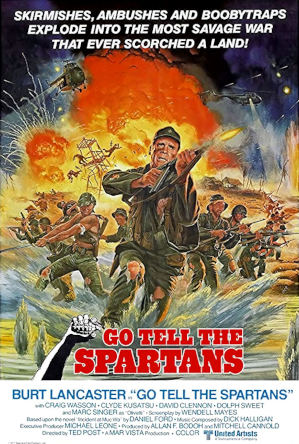
The title comes from Simonides of Ceos’ Epitaph, a quote by Herodotus, the Greek historian, about the famous Battle of Thermopylae in 480 B.C. Greece. 300 Spartan soldiers held a mountain pass against the entire Persian army; they all gave their lives, but the delay allowed Greece to prepare for their victory at Salamis. The epitaph of the Spartan soldiers reads “Stranger, go tell the Spartans that here we are buried, obedient to their orders.”
The first time he hears about Muc Wa, a military outpost left behind by the French in Vietnam, the major makes his thinking clear: He pronounces it so that the second word begins with an ‘f’, and rhymes with the first. In the early war year of 1964, Muc Wa has no significance; no Cong sightings have been reported within 50 miles. But U.S. headquarters in Da Nang wants Muc Wa occupied and defended (…) Go Tell the Spartans considers the war in Vietnam in terms of the microcosm of Muc Wa in 1964, and so contains a lot of statements that are meant to be prophetic in hindsight (…) Ted Post is apparently directing on a modest budget, and yet he creates a realistic war scape and believable characters. The most believable is Burt Lancaster, who brings a nice subtlety to his character. – Roger Ebert, 1978.
 Pop9
Pop9 