
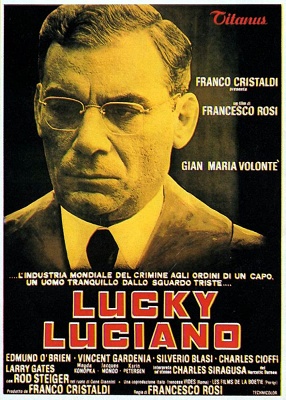
His subtle, enigmatic performance aside, [Volonte‘s] mere presence in the film signals Rosi‘s intention to place crime squarely in the context of capitalism.
The varied shots of burly sinister men in overcoats and dark glasses getting in and out of cars constitute a kind of ballet of power, just as much as the multiple depictions of brutal killings do. “Mean men at work”, these compositions say, with a kind of droll resignation. The subordinate role of women in this world is of course a given.
The film jumps between various time frames in a seemingly arbitrary fashion, creating a mosaic effect that actually effectively underscores Rosi’s theme of eternal corruption. Money and power are ever and always the constants, no matter what ways the “culture” changes. Money and power are the culture, finally.
Thus, this anachronistic shot of Luciano gazing at a 1970’s skyline of lower Manhattan as his vessel sets sail in the 1940s has to be seen as an entirely deliberate gaffe. This kind of broker is always with us, it says. This movie takes place then, but it might as well be now. — Glenn Kenny
 Pop9
Pop9 