
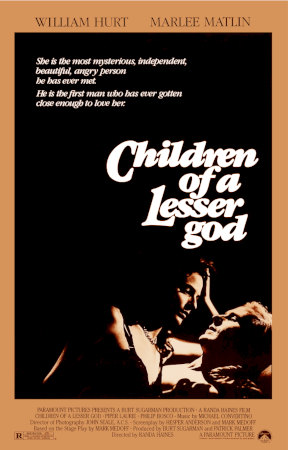
The movie makes a deliberate decision to exist in the world of the hearing. I know why they made this decision. It was dictated by the box office, but that doesn’t make me feel any better about it. There is a certain cynicism at work here: Most of the people who see this movie will be able to hear, and although they may welcome the challenge of a movie about a deaf person, they aren’t so interested that they want to experience deafness (…). I’m not suggesting silent scenes where we have to guess what the sign language means. But how about a few silent scenes in which the signs are translated by subtitles, giving us something of the same experience that deaf people have (they see the signs, and then the subtitles, so to speak, are supplied by their intelligence) (…). This objection aside, “Children of a Lesser God” is a good but not a great movie (…). A competent, professional docudrama. Roger Ebert, 1986.
To appreciate “Children of a Lesser God,” you only have to imagine how it could have patronized the deaf by celebrating their pluck, or become a heartwarming tale of little people who solve their big problems. That’s exactly what it isn’t, and that’s quite an achievement. Paul Attanasio, 1986.
 Pop9
Pop9 