
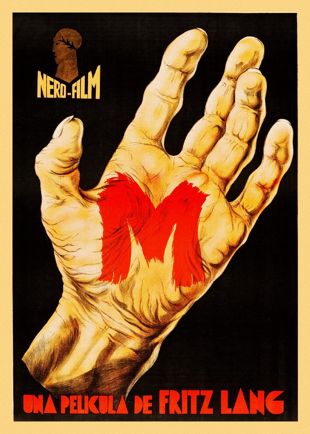
When you watch “M,” you see a hatred for the Germany of the early 1930s that is visible and palpable. Apart from a few perfunctory shots of everyday bourgeoisie life (such as the pathetic scene of the mother waiting for her little girl to return from school), the entire movie consists of men seen in shadows, in smokefilled dens, in disgusting dives, in conspiratorial conferences. And the faces of these men are cruel caricatures: Fleshy, twisted, beetle-browed, dark-jowled, out of proportion (…). And what a haunting film it is. The film doesn’t ask for sympathy for the killer Franz Becker, but it asks for understanding: As he says in his own defense, he cannot escape or control the evil compulsions that overtake him. Elsewhere in the film, an innocent old man, suspected of being the killer, is attacked by a mob that forms on the spot. Each of the mob members was presumably capable of telling right from wrong and controlling his actions (as Becker was not), and yet as a mob they moved with the same compulsion to kill. There is a message there somewhere. Not “somewhere,” really, but right up front, where it’s a wonder it escaped the attention of the Nazi censors. Roger Ebert
 Pop9
Pop9 